

A decarbonization movement has gained traction in marketing new equipment for real estate in the past couple years.
It’s noble on the surface. What company doesn’t want to do its small part in making the world a better place for all its inhabitants?
And what engineer doesn’t want to be on the cutting edge of the field?
But there’s something else going on below the surface. And while it leads to higher revenue per unit, it could mean more money out of building owners’ pockets.
Those owners’ budgets are already stretched thin. That may not be sustainable for an OEM’s top line.
Sunny Promises
I’ve heard it said the responsibility for any product claim falls on the company making them. But I’m of the mind if a copywriter knows better, he has a responsibility to highlight it.
So, how does “decarbonization” work in practice?
The start is with electrification of appliances over using natural gas. Think heating appliances for building air and water systems. And, typically, they boast higher efficiency numbers. That should be a good thing, right?
The assumption is more installations of solar panels will feed “free” energy into these electrically-based systems. That should lower the cost of operating the building, right?
If we can just scale it big enough, everything should work the way we planned it, right?
Wait, where have we heard that before…
Shadowy Promises
But there’s a gaping hole in implementation: Where do we get electricity in the meantime?
That’s going to have to come from the grid. And those numbers don’t look as sunny.
You see, only about 7% of electricity makes it from the generator, through the transformers, across transmission lines, and to the end user. That’s you, the building owner.
So when you compare gas to electricity, you’re paying for those losses in the meantime. Even if someday you’ll be generating it locally.
I had to do the same calculations in 2011 multiple times when I sat for my Certified Energy Auditor exam. The economics haven’t really changed since then.
A 70% efficient gas appliance is still cheaper to run than an electric appliance that’s 90% efficient. That’s true all the way to gas being $14/DTH, which takes some pretty wild market distortions to achieve.
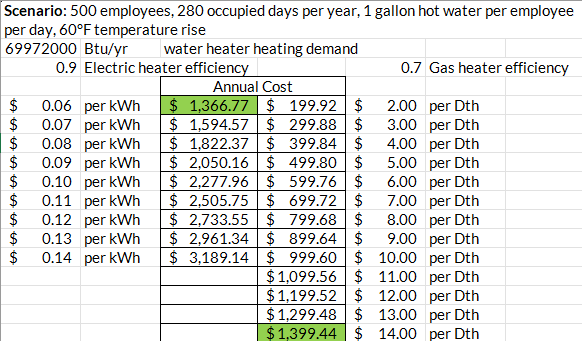
Now, that doesn’t mean there hasn’t been progress. Over a decade of improvements has pushed efficiency for new water heaters over 90%.
But that goes for new gas heaters, too. Which skews the economics even more.
Foggy Paths
Yes, we want to be green. And burning natural gas makes carbon dioxide. But can you call it decarbonization when you burn diesel in your backup generator?

A large share of that gas comes as a free-ish byproduct of fracking for oil. You could use it to heat your building. Or the driller can flare it off at their site.
Plus, we’re facing a time when grids only have 10-15% spare generating capacity. And the rapid expansion of data centers for AI infrastructure is quickly eating into that cushion.
Not to mention the new equipment uses a more flammable refrigerant that requires even more complex controls and sensors. Building managers like you still need to ensure continued safe operation for your buildings.
By the way, what do all those new controls mean for your total service costs?
Finally, consider seriously what will happen to these new technologies under President Trump. He already froze rule-making for federal agencies pending further review. That leaves these OEMs vulnerable to more affordable substitutes.
So the question is: should you move now or wait?
Shining Through the Clouds
The bottom line is the bottom line hasn’t really changed. Even if the marketing campaign has.
This game is still about saving money, both for your building and the power company.
Decarbonization should not be two ideals at odds with each other. The claims made for this equipment would only provide marginal benefit, if not more pain. And the only way they could have seen the light of day was with government backing.
I get the really freaking cool aspect of projects these OEMs are working on. In the best light, they’re pushing physics and chemistry to make our lives better.
Plus, at the end of the day, we all want to put our names behind something we’re proud of.
I mean, this is why I had panels installed on my house in 2018. The economics just made sense. And now I’m almost 7 years into a 9-year payback cycle.
So do your homework around decarbonization marketing. It is possible to save money and do cool things while being a part of something bigger. Just make sure the economics make sense for you.
How will these changes affect your buildings? Leave a comment below and subscribe for more thought leadership.
Does your company need help scaling a cool new technology that can help people? Book a call with me today. We’ll find what’s missing with your value proposition and get your message right for your ideal customers.
 Promethian Impulse, LLC
One thought on “Should you buy into decarbonization marketing?”