
I started out sucking at sales. And it almost cost me everything.
You see, I tried to leap from manufacturing to the unknown of digital marketing. I still love manufacturing, but I hated feeling like I was running into a wall.
I needed a better way to interact with like-minded people and sell ethical products I believed in.
The writing organization I joined had me believing I could go from zero to landing a retainer in the next 4 months. Just enough time to setup my new venture.

(credit: Morgan Creek Productions)
What followed was a grinding series of events.
Clients were not coming on board, despite my efforts. I reached out to client-getting summits, old friends, and professional connections. But no one wanted my services.
I couldn’t figure it out. And I couldn’t provide for my family of seven like this.
Then came an opportunity to take the Sales Gateway training through LifeHikes. If I was going to find my problem, this seemed like the place to do it.
What’s a LifeHike?
If the Great Resignation showed us anything, it’s that poor leadership costs organizations a lot of money. Losing the right people can lose sales, miss orders, or ship poor quality products.
If you want to get your small business right, you have to do relationships right. And if you can lead relationships in sales, your business will do well.
In the case of this class, it’s about building a relationship with your prospect. This method of sales is an honorable profession. You’re there with the right tools to meet people’s needs.
There’s a lot of bad advice out there. And a lot of aggressive personalities. This won’t work when you’re asking the prospect to make a long-term commitment with a complex product.
This course is for new sales professionals who can just bumble through their pitch. They’ve brought some AI on board to support a cadre of seasoned sellers giving feedback.
These tools can achieve a step-change in confidence for new sellers. It’s about getting clear on the how and why their product adds value.
And I was in sore need of improvement.
What was wrong with my approach?
I had two small group assignments to empathize with a prospect. The prospect would give me a clue about a problem I needed to empathize with.
Spoiler alert: I blew both chances.
First Try
I was selling a retirement advisory software service to a professional who was about to lose her job.
Practical me, I hear she has an accelerated timeline. So I highlight the software’s ability to recommend investments on it. That should help her feel confident even without a job, right?
But I didn’t explicitly ask for more details or reflect what she told me about her situation. And there went her attention.
Second Try
I was making a pitch of my copywriting services to a different potential client. Her clue was she was pursuing an MBA. This consumed whatever free time remained after her demanding workload.
Practical me stepped in again. I suggested my services to save her time. With a little outsourcing, she could complete everything.
But this approach didn’t stop to acknowledge the hard time she was having now.
Did I learn anything?
Both cases taught me to spend more time addressing the specific concern my prospect gives me. I don’t build relationships assuming the benefits I’m selling automatically cover their concerns.
Lucky for me, problem-solving for manufacturing already gave me a framework to improve. This class finally helped me realize sales is no different.
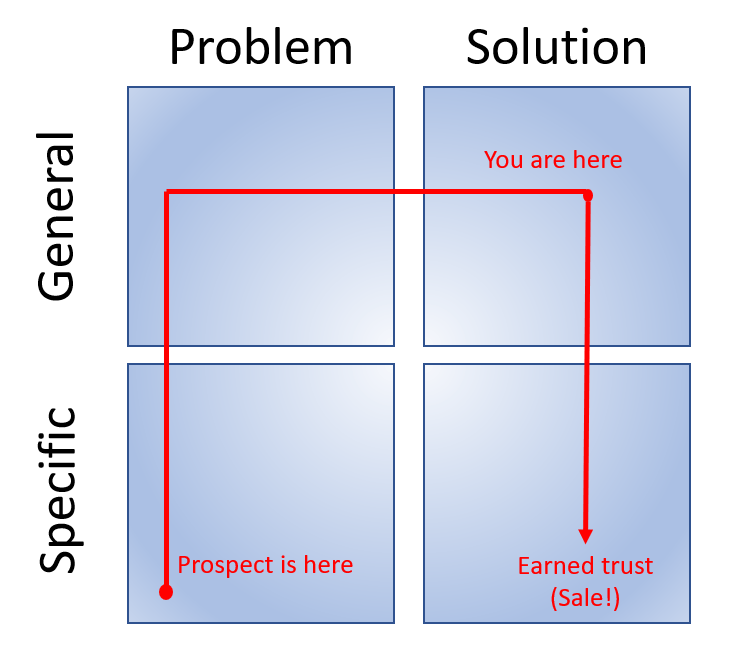
I can see where my prospect is. And I know what my solution can do. But just being smart isn’t helping.
Unless I can walk them from where they are to where my product is, I won’t get them to see how much it can help.
Assume everyone you pitch to can’t see past their specific problem as an anomaly. You can’t talk to them from a broad perspective until you show empathy to that specific problem.
“Yes, my product can solve your problem.” But you as the seller haven’t guided them to how it meets their needs, let alone that it meets their needs.
This was a powerful realization that gave me a path forward to improve.
Ignoring your blind spots can cost you everything. And I am grateful to LifeHikes for uncovering them.
Does your sales force need help communicating the value of your small business? Be sure to check out this and other upcoming courses on LifeHikes.
Are these insights useful for you? Find out more about what I do here.
 Promethian Impulse, LLC
One thought on “Your Small Business Can Get Better at Selling”